- Fiscal.ai
- Posts
- 🗞 The “Uber” of Southeast Asia?
🗞 The “Uber” of Southeast Asia?
How a Harvard Business School project turned into a $17B SuperApp


Braden Dennis & Ryan Henderson
March 08, 2026

Written by: Ryan Henderson & Braden Dennis
Happy Sunday! 👋
Today we’re taking a look at how a 2011 Harvard Business School project became a $17 billion SuperApp. This is the “Uber” of Southeast Asia.
Let’s dive in!
Platform Update
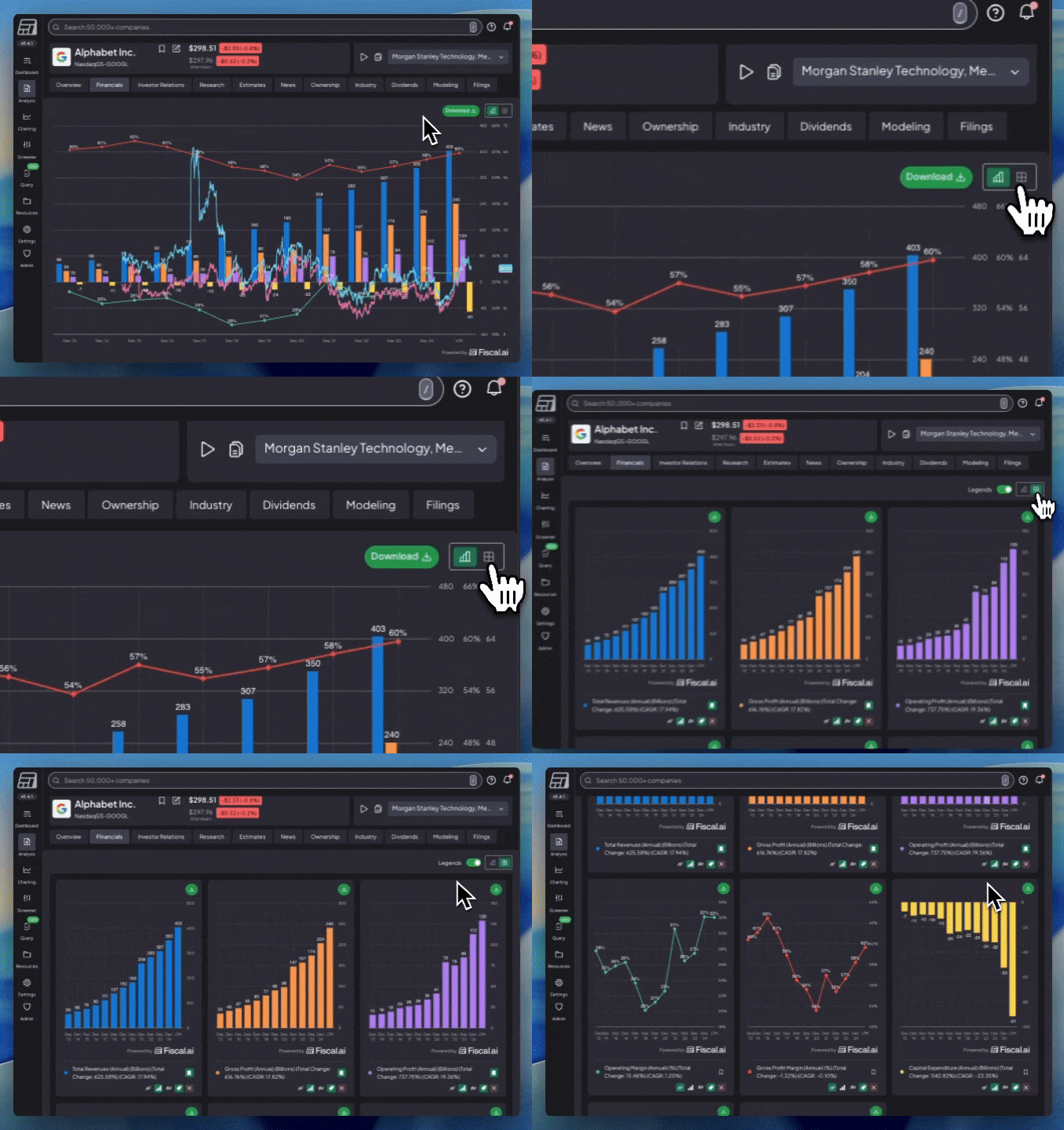
Introducing Grid View
This week, Fiscal.ai launched Grid View.
With a single click, clients can now isolate individual metrics from within complex charts.
Featured Story
The “Uber” of Southeast Asia
“Grab today serves 1 in 15 Southeast Asians monthly, up from 1 in 20 just three years ago. More importantly, approximately 2/3rds of our users now use two or more services on our platform…Once you reach this level of density, growth stops being linear. It becomes self-reinforcing, and as we introduce more new products in the years to come, the ecosystem will compound further. I am confident that we will be able to sustain this growth momentum in the years to come”

A Safer Taxi System
In 2009, Anthony Tan and Tan Hooi Ling met while searching for Asian food on campus during their first year at Harvard Business School. As the two Malaysian-born students grew closer through shared classes, they discussed a common problem they had witnessed back home in Malaysia: Taxi Safety.
At the time, many individuals (especially women) felt that the taxi system in Malaysia was unsafe. Unsafe driving practices, robberies, assaults, and even kidnappings, were concerns that women in Kuala Lumpur (Malaysia’s capital) had to worry about.
In fact, prior to her MBA, while Tan Hooi Ling was working at McKinsey in Kuala Lumpur, she recalls having to pretend to be on the phone with her mother as a security measure. Without knowing it, Tan Hooi Ling and her mother had built essentially a “manual GPS system” that would eventually become the architecture behind Grab’s business model. When Ling ordered a taxi, she would text her mother the license plate number and her progress throughout the drive as she passed certain landmarks. Ling realized this system was something everyone could benefit from.
Two years after initially meeting, Anthony Tan and Tan Hooi Ling teamed up and pitched this taxi tracking system at the Harvard Business School New Venture Competition in 2011. The proposal won 2nd place taking home a $25,000 prize, and sparking the genesis for what would one day become Grab.
Following their success at the startup competition, Anthony Tan and Tan Hooi Ling officially launched their company and named it “MyTeksi”. The idea – a GPS enhanced mobile app that connected passengers with nearby taxis – was not necessarily novel for Malaysia at the time (since Uber was already expanding there), but MyTeksi’s local expertise enabled them to win market share anyways.
“Driving” Adoption

As with any marketplace business, building a functioning platform is just the tip of the iceberg. The real challenge, particularly in the early days, is driving network adoption.
Thanks to their knowledge of the Malaysian market, Anthony Tan and Tan Hooi Ling prioritized features that they knew would address specific pain points for Malaysian customers. Not only did MyTeksi have unique safety features like “Share My Ride” functionality and an emergency button, but they also accepted cash payments, while Uber required credit cards. This was a major selling point because Malaysia (and most of Southeast Asia at the time) were still cash-dominant economies.
But attracting riders was actually the easier part. The MyTeksi app was a superior experience to traditional taxi rides pretty much across the board. The rides were traced, drivers were pre-verified, prices were transparent, and rides were predictable. So it wasn’t too much of a surprise that adoption quickly picked up among consumers.
Drivers, on the other hand, were harder to convince.
Despite increasing efficiency for drivers and reducing “dead mileage” time, Anthony Tan recalls having to manually recruit and educate drivers who were skeptical of the technology. For example, when MyTeksi was attempting to expand into Ho Chi Minh City in Vietnam, Tan discovered that the drivers would gather at gas stations at around 4:00AM to grab a coffee before their shift, so Tan began showing up at those hours providing free coffee and pitching them on joining the platform.
Tan went fleet-to-fleet and driver-to-driver convincing them of the benefits of MyTeksi. Tan even says he was essentially “begging” drivers to join in the early days, and out of every 10 pitches, maybe 2 would agree to join the app.
As difficult as this “boots on the ground” strategy was, MyTeksi did eventually brute force their way to sufficient scale in key cities. And once there were enough drivers and riders on the marketplace, the local network effect took over and the supply of existing drivers and riders began attracting new potential customers.
By 2015, MyTeksi had amassed over 200,000 drivers, 11+ million app downloads, and had officially become Southeast Asia’s first “unicorn”. The app that was founded out of a college start-up competition had officially reached escape velocity.

Overcoming Uber
By 2018, MyTeksi (which had rebranded to GrabTaxi, then Grab) was in the midst of stiff competition with the leading global ridesharing marketplace, Uber.
But Grab, who had already raised 6 separate funding rounds by this time, was willing to accept financial losses in the short term in order to win market share. That meant fighting a seemingly endless subsidy battle with Uber to see who could attract more drivers and riders.
Fortunately for Grab, however, by 2018 Uber was entering a transitional period. Founder Travis Kalanick, who was pursuing more of a “growth at all cost” strategy, had just stepped down, and the company was looking to improve profit margins ahead of their planned public offering.
To settle the competition, Softbank (who was the lead investor for both Grab and Uber at the time) helped the two companies come to a resolution. Grab would acquire Uber’s Southeast Asian operations and Uber would get a 27.5% stake in Grab. It was a win-win. Grab consolidated market share and Uber curbed losses before their big IPO.
To this day, Uber remains one of Grab’s largest shareholders.

That’s all for this week.
If you have any questions on Fiscal.ai or feedback for the newsletter, feel free to reply to this email!