- Fiscal.ai
- Posts
- 🗞 The "Amazon" of South Korea?
🗞 The "Amazon" of South Korea?
How a "Groupon Copy-cat" became an e-commerce juggernaut


Braden Dennis & Ryan Henderson
January 25, 2026

Written by: Ryan Henderson & Braden Dennis
Happy Sunday! 👋
Today we’re taking a look at one of the most successful business pivots of the last 2 decades. This is the story of Coupang.
Let’s dive in!
Featured Story
Coupang: The Amazon of South Korea
“Now, a customer who realizes that she needs new tires on her car can purchase them online from home and have them delivered and installed the very next day… Now, a customer who forgets an important birthday can order with a few clicks on his phone just before midnight and have fresh flowers, ice cream, and a cake waiting at the door for his significant other when they wake up the next morning.”
“Our culture of relentless innovation fuels not only growth, but also continuous improvements in our processes and margins. We have always believed that customer experience and operational excellence can advance hand in hand. Better processes lead to better outcomes for customers. By innovating tirelessly on behalf of customers, we're simultaneously driving down costs and raising the bar on service quality.”

In 2014, a Harvard Business School dropout named Bom Suk Kim decided to pull the IPO of his promising social commerce company just one week before the offering prospectus was set to be published.
The 35 year old Korean-born founder was having second thoughts about the company he had started just 4 years earlier. At the time, Coupang had evolved from a “Groupon-like” daily deals site into a rapidly growing marketplace for 3rd party goods.
While this business model had seen massive adoption in South Korea (more than $1 billion in sales at the time), Kim had a “nagging feeling” that they weren’t providing enough value to customers.
Kim made the difficult decision to shelf the offering and go back to the drawing board.
Right then, he set out the blueprint for how they would build a company that customers “couldn’t live without”.
Coupang Today
Today, Coupang is the leading vertically integrated e-commerce provider in South Korea.
For all intents and purposes, the “Amazon of South Korea” analogy is a great fit here.
Coupang’s online marketplace is home to 24.7 million active customers (that’s ~48% of South Korea’s entire population), and consists of a mix between 1st party items and items from 3rd party sellers.
A customer can buy just about anything they need on Coupang from everyday necessities to fresh groceries or even a set of new tires for their car.
What truly makes Coupang stand out from other Korean e-commerce providers like Naver or Gmarket is the speed of delivery. When Bom Kim shelved the initial IPO in 2014, roughly half of Coupang’s customer complaints were about shipping times. To deliver a service that customers couldn’t live without, Kim knew they had to start investing heavily in the delivery side of the business.
That not only included investments in physical assets like fulfillment centers, warehouse robotics, and a custom vehicle fleet, but it meant optimizing their delivery algorithms with systems like dynamic route optimization and predictive demand modeling.
This gave Coupang an early leg up that still persists to this day.

Unparalleled Fulfillment:
Just how fast is Coupang Delivery?
Today, 99% of Coupang’s orders are delivered in less than 24 hours. For comparison, roughly 60% of Amazon Prime orders are delivered same-day or faster in the U.S.
Coupang’s “Rocket” delivery service also includes a “Dawn Delivery” option on most items, which guarantees orders placed by midnight will be delivered to the customer’s doorstep by 7 a.m. the following morning.
How? Network density.
In their 2021 IPO Prospectus, Coupang revealed that 70% of the South Korean population lived within 7 miles of a Coupang fulfillment center.
That was 2021, and Coupang has nearly tripled its fulfillment capacity since.

It also helps that South Korea is one of the most densely populated countries in the world.
To put some numbers on it, in South Korea, there are about 531 people per square kilometer. In the US, that figure stands at ~38.
This remarkable population density enables Coupang to be more efficient. More deliveries per square kilometer means drivers are spending less time on the road in between deliveries.
This delivery advantage is also self-reinforcing.
Better delivery times → More orders
More orders → Better driver utilization
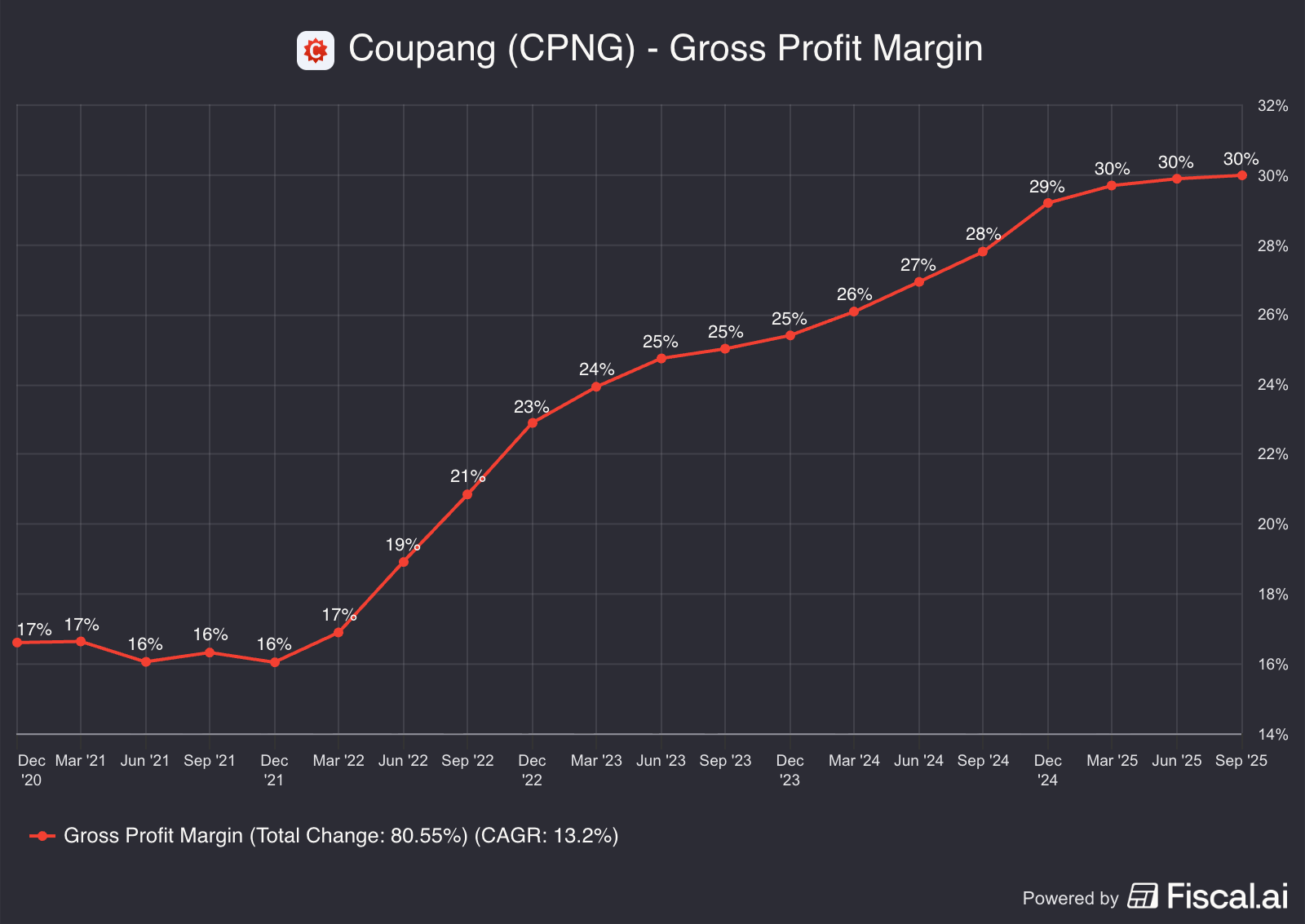
Better driver utilization → Higher gross profit margins
Higher gross profit margins → More money to reinvest in infrastructure
More infrastructure investments → Better delivery times
And on, and on, the cycle repeats.
This greater efficiency is evident in their gross margins.
Platform Update
New Search Modal
Fiscal AI just launched a brand new search modal.
Cut out the clicks and go straight to the specific page you’re looking for straight from the keyboard
For example, you can search:
