- Fiscal.ai
- Posts
- 🗞 Did AI Kill Consulting?
🗞 Did AI Kill Consulting?
Inside the sudden collapse of the consulting industry


Braden Dennis & Ryan Henderson
April 12, 2026

Written by: Ryan Henderson & Braden Dennis
Happy Sunday! 👋
In this week’s edition of “which industry did AI to disrupt now?”, we’re taking a look at the sudden collapse of the consulting sector.
Let’s dive in!
Featured Story
Did AI Kill Consulting?
Generally speaking, there are 3 reasons companies hire consultants.
Capacity: A company might simply lack the bandwidth or resources to tackle a certain project. In this case, it can often be cheaper to hire a temporary consultant, instead of recruiting, onboarding, and hiring a full-time employee.
Capability: This could also be known as “renting expertise”. For certain problems, it’s better to bring in a consultant who has experience in a specific domain. Examples include large ERP implementations, mergers or acquisitions, entering new international markets, and tons more.
Cover: Sometimes a company just needs a scapegoat. They need the involvement of a 3rd party in order to appear objective. For example, hiring a compensation consultant for executive pay or relying on an “independent review” to announce major layoffs.
While some people are ethically against the 3rd reason (cough, cough Charlie Munger), capacity, capability, and cover have generally withstood the test of time as reasons to bring in consultants.
“I’d rather throw a viper down my shirt front than hire a compensation consultant.”
But with the recent rise of AI, and specifically the automation of manual tasks, investors now seem a little more wary of the consulting industry’s durability.
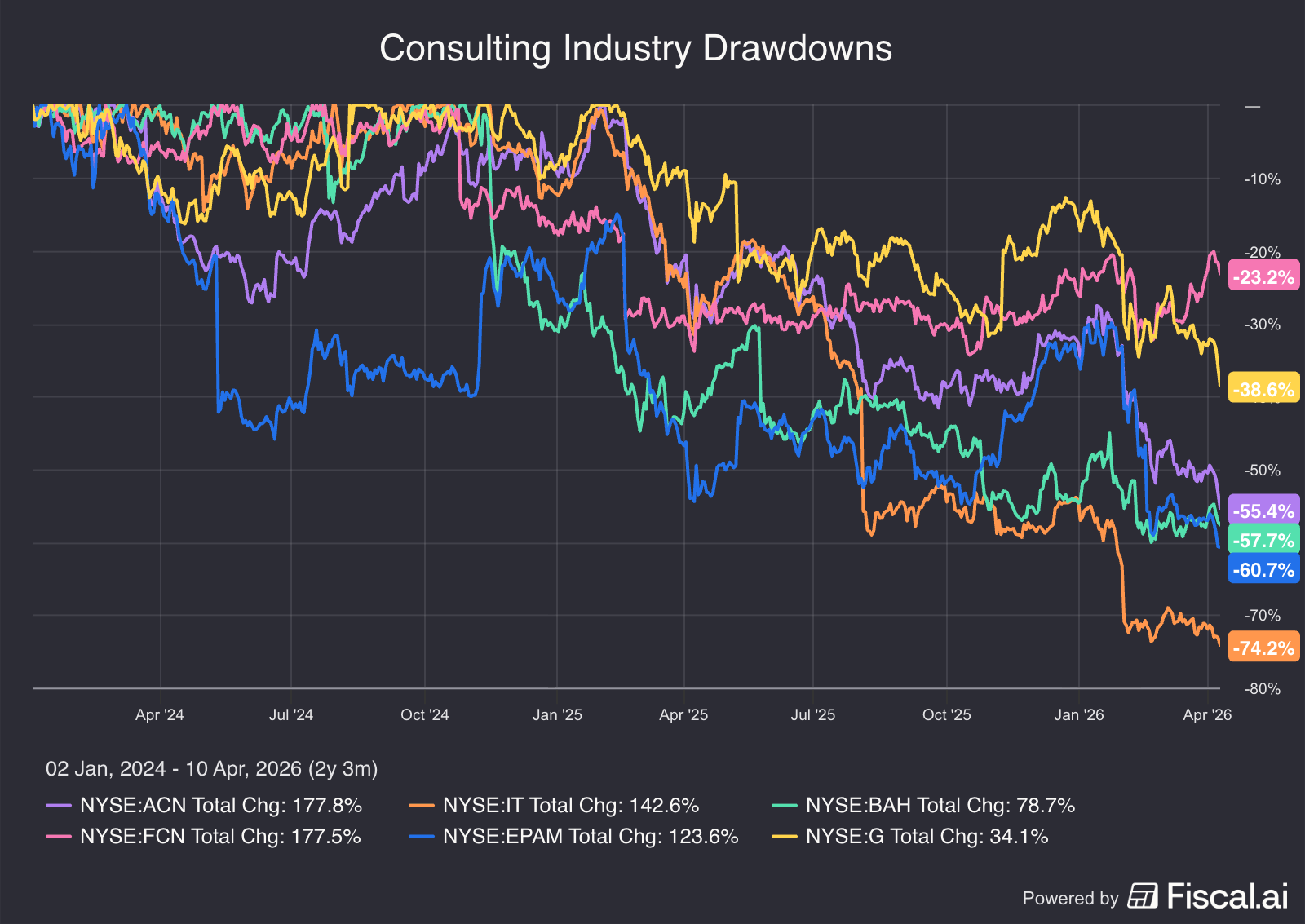
Most of the publicly traded consulting companies are experiencing significant drawdowns:
FTI Consulting: -23%
Genpact Limited: -39%
Accenture: -55%
Booz Allen Hamilton: -58%
EPAM Systems: -61%
Gartner: -74%
Is AI actually hurting consulting companies?
AI has, without question, put pressure on the traditional consulting model of hiring large cohorts of junior analysts to conduct research. AI excels at tasks like data retrieval and slide-building, which is where many junior consultants spend a good portion of their time.
Clients, for the most part, are aware of the productivity gains AI enables, which is forcing consulting companies to rethink their pricing models and talent structure. Instead of charging for billable hours, consultants are now having to sell based on specific outcomes.
To help with this evolving pricing structure, data shows that consulting companies are hiring fewer junior-level employees, and instead shifting the hiring focus to more specialized roles in AI development, data science, and engineering.
Let’s take a deeper look at a few of the public consulting (or consulting-adjacent) companies:
Accenture is the largest IT consulting firm in the world, home to more than 800,000 employees globally.
Morningstar describes the business well (you can find the latest Morningstar report here on Fiscal.ai):
“Accenture is the only IT services company that has the capability to deliver end-to-end business solutions. If a brick-and-mortar bank is planning to launch a mobile banking app, Accenture is ready to assist it throughout the entire process, which includes overarching strategy design, IT system integration, custom application development, new service marketing, and digital infrastructure management.”
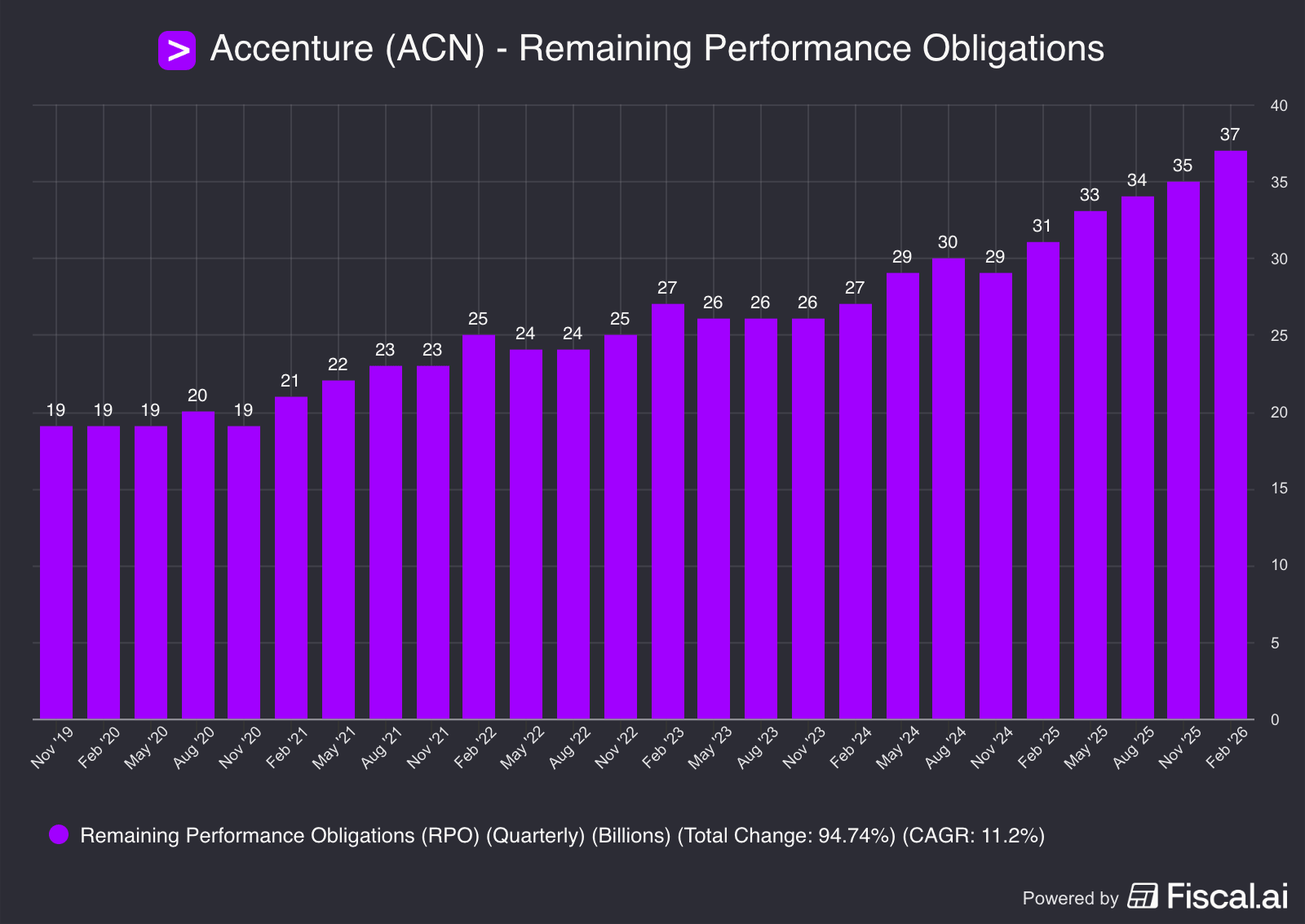
Accenture’s IT-specific focus puts them on slightly better footing than competitors amidst the AI threat, as their clients are actually turning to them to implement AI solutions.
Despite what the recent stock price drawdown might make investors think, the positioning of being a company’s “AI implementation partner” has actually led to an acceleration in backlog growth over recent quarters.
EV/EBIT: 10.6x
5yr Revenue CAGR: 6.1%
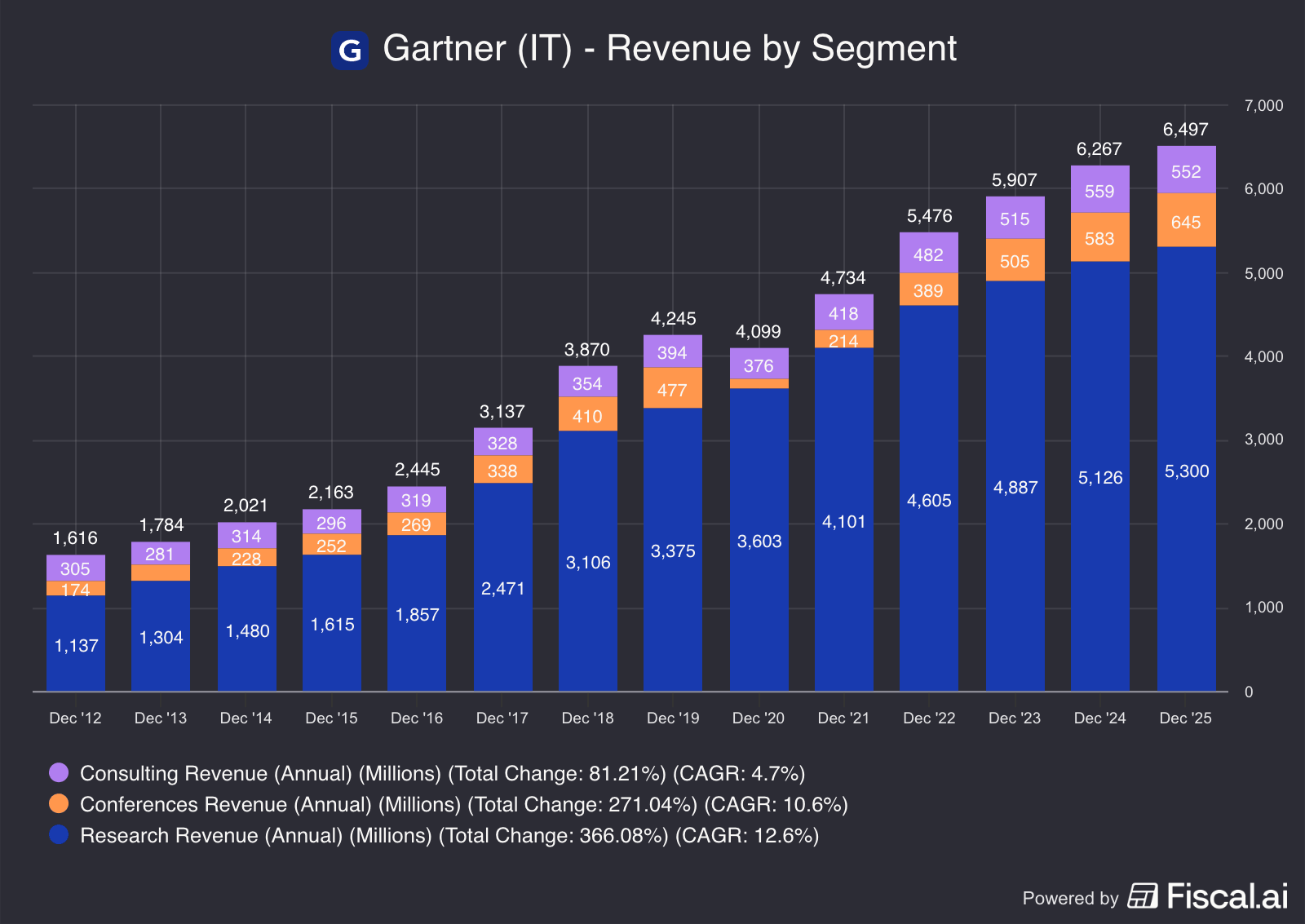
While Gartner has a consulting arm, the bulk of their revenue actually comes from selling their research to the IT industry.
For many IT professionals, Gartner is the go-to source for the latest industry insights. With more than 2,400 experts, Gartner is able to produce high quality research that covers many different industries. Gartner then sells that research typically through multi-year, upfront subscriptions.
As AI has reduced the time and effort required to pull together information, customers are starting to push back against Gartner’s pricing model. Last quarter, Gartner reported 2% revenue growth, which is their slowest rate on record. This deceleration in growth has driven the stock down 63% in just the last year alone.
EV/EBIT: 11.4x
5yr Revenue CAGR: 9.6%
EPAM Systems is an IT services firm that caters to companies looking to outsource software development.
EPAM was founded in 1993 with the goal of linking US-based software companies to the massive (and underutilized) engineering talent pool in Eastern Europe. This model worked exceptionally well for nearly 3 decades as EPAM was able to offer high-quality software developers at a fraction of the cost of their US counterparts.
However, with the bulk of their workforce based in Ukraine, the Russia-Ukraine war put a major dent in operations starting in 2022. While EPAM was able to successfully relocate most of their employee-base, they’re now facing a new headwind from the rise of tools like Claude Cowork and OpenAI Codex.
Although EPAM has reaccelerated growth since navigating the geopolitical risk, investors now fear that these AI tools will diminish the need for engineers in general.
EV/EBIT: 10.5x
5yr Revenue CAGR: 15.5%

That’s all for this week.
If you have any questions about Fiscal.ai or any feedback for the newsletter, feel free to reply to this email!